The investment landscape in 2026 looks nothing like it did five years ago. Stock market volatility has whipsawed retail investors through repeated 10%+ corrections. Crypto continues its boom-and-bust cycle, with even institutional holders rotating out after the latest regulatory shifts. And the great American dream of building wealth through rental properties has run into a wall of rising interest rates, ballooning insurance premiums, and tenant-friendly legislation in dozens of states.
So where is smart money quietly moving?
Land.
Not glamorous skyscrapers or trophy commercial assets — raw, vacant, undeveloped land. Particularly in the Sun Belt and rural growth corridors. According to recent data from the National Council of Real Estate Investment Fiduciaries (NCREIF), farmland and timberland have delivered consistent 10–12% annualized returns over the past two decades — outperforming the S&P 500 on a risk-adjusted basis. And that’s just the institutional segment. Recreational, residential infill, and “rural-but-buildable” parcels — the segments most accessible to individual investors — have quietly become one of the most resilient asset classes in real estate.
The catch? Land has historically been the hardest real estate asset to evaluate without boots on the ground. That’s changing fast, and tools like ParcelView3D are at the center of that shift.
The Quiet Migration: Why Investors Are Rotating Into Land
Let’s break down why land is winning the attention of investors who, just a few years ago, were exclusively in equities, REITs, or short-term rentals.
-
Stocks: All the Volatility, None of the Control
Equity investors don’t control product roadmaps, executive decisions, share buybacks, or geopolitical exposure. A single CEO scandal or earnings miss can erase 20% of a position overnight. Even index investors have watched broad-market indices stagnate for months at a time while inflation eroded purchasing power.
Land offers something fundamentally different: tangible ownership of a finite resource. They aren’t making any more of it. When you own a 5-acre parcel in a growth corridor, no quarterly earnings report can vaporize half its value before market open.
-
Crypto: Speculation Without Substance
Bitcoin, Ethereum, and the broader crypto ecosystem have generational upside — and generational drawdowns. The 2022–2023 contagion wiped out hundreds of billions in retail wealth. Even the more “stable” tokens are subject to exchange collapses, custody risk, and policy whiplash that makes long-term planning nearly impossible.
Land doesn’t get hacked. Land doesn’t get delisted. Land doesn’t disappear because some founder in the Bahamas misappropriated customer funds.
-
Rentals: Cash Flow Comes With a Price Tag
Single-family rentals were the darling of 2015–2021. But the math has shifted. Insurance premiums in Florida, Texas, and California have doubled or tripled. Property tax reassessments are eating into yields. Eviction timelines in some jurisdictions now exceed 12 months. And cap rates compressed during the easy-money era haven’t expanded enough to offset rising costs.
Worse, rentals come with operational drag — late-night maintenance calls, vacancies between tenants, contractor disputes, and the ever-present risk of property damage. Owner-financed land sales, by contrast, deliver predictable monthly income with no toilets to fix and no tenants to evict.
-
Land: The Asset Class Built for the Long Game
The case for land isn’t just “less bad than the alternatives.” It’s compelling on its own merits:
-
Multiple exit strategies — hold, flip, subdivide, owner-finance, lease for hunting or agriculture, develop, or sell to a neighbor for assemblage
-
Tax advantages — conservation easements, 1031 exchanges, agricultural exemptions, and step-up basis at inheritance
-
Low carrying costs — no roof to replace, no HVAC to service, often minimal property tax on raw acreage
-
Inflation hedge — land prices have historically tracked or outpaced inflation across nearly every measurable cycle
-
Owner financing creates yield — sellers can structure deals at 9–12% interest, generating returns that crush most fixed-income alternatives
The challenge has always been knowing what you’re actually buying.
The Old Way: A Recipe for Costly Mistakes
For decades, land investors operated on grainy aerial photographs, county GIS maps from the early 2000s, and — when budgets allowed — expensive cross-country trips to physically walk parcels. Most investors couldn’t justify the travel, so deals were either passed on entirely or closed on faith.
The result? An entire industry built on inefficiency:
-
Investors buying flood-prone parcels because elevation wasn’t obvious from a 2D map
-
Wholesalers passing on profitable deals because they couldn’t visualize access
-
End buyers backing out of closings after their first site visit revealed something the photos missed
-
Owner-finance defaults driven by buyer’s remorse from properties that didn’t match expectations
The hidden cost of bad land decisions runs into the billions every year. And it’s almost entirely preventable.
How ParcelView3D Is Changing the Decision-Making Process
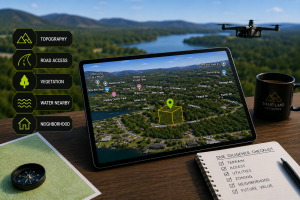
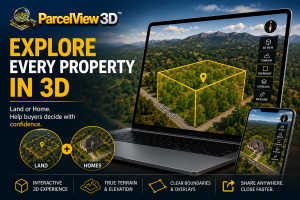
ParcelView3D was built specifically to solve the visualization gap that has plagued land investing since the asset class existed. By rendering parcels in true three-dimensional context — terrain, surrounding structures, vegetation, road access, and topography — investors can evaluate a property as if they were standing next to it, from anywhere in the world.
This isn’t a satellite snapshot. It isn’t a generic mapping tool retrofitted for real estate. It’s purpose-built infrastructure for land professionals who need to make confident decisions quickly.
What That Means in Practice
A wholesaler in Tampa can evaluate a 10-acre parcel in rural Oklahoma in under three minutes. A buyer in California can virtually walk their potential homestead in Tennessee before wiring a deposit. A land flipper can screen 200 leads in an afternoon and immediately identify which ones have access issues, slope problems, or surrounding incompatibilities that would kill resale potential.
Key capabilities that have made ParcelView3D the platform of choice for land professionals include:
-
Immersive 3D parcel views with terrain, structures, and surroundings rendered in context
-
Embeddable visualizations that land sellers and agents can drop directly into MLS listings, Land.com, LandWatch, and Facebook Marketplace ads to dramatically increase buyer confidence and conversion rates
-
Site planning tools to evaluate ADU placement, building envelopes, and access drives before closing
-
Research overlays covering flood zones, wetlands, mineral rights, and state-specific regulatory layers (Vermont’s Act 250, Texas mineral severance, Oklahoma surface damages, and more) — explore the full research stack at the ParcelView3D research hub
-
Concept Builder that lets sellers visualize what a property could become — a powerful tool for marketing and price justification