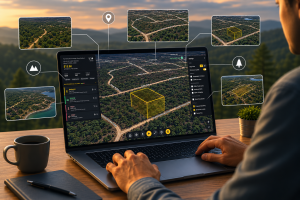
How Link & Bundle in ParcelView3D turns scattered parcels into one high-value opportunity buyers actually compete for.
You picked up five adjacent lots from one seller because together they’re something: 47 contiguous acres, a lake-area block, a buildable assemblage worth real money. Then you got back to your desk and did what everybody does — you split them into five separate listings.
And just like that, you turned one strong opportunity into five weak ones.
Each lot now looks small on its own. Buyers scroll past them as “just another parcel.” You’re running five sets of photos, five descriptions, five follow-up threads — and quietly competing against yourself, because the buyer who likes Lot 3 has no idea Lots 1, 2, 4, and 5 sit right next to it. The package that made the deal attractive in the first place is invisible.
That’s parcel fragmentation, and it’s one of the most expensive habits in land marketing. The fix isn’t more flyers. It’s showing buyers the whole opportunity at once.
What splitting a package actually costs you
When you market adjacent parcels separately, you lose on four fronts at the same time:
- Perceived value collapses. “5 acres” reads as small. “47-acre investment bundle” reads as an opportunity. Same dirt, completely different buyer reaction.
- You compete with yourself. Two listings in the same area pull buyers in different directions instead of stacking interest onto one compelling package.
- Buyers can’t see the relationship. A static map or a screenshot can’t show how the lots fit together — the contiguous frontage, the shared access, the shape of the whole block. So the buyer never grasps why the assemblage is worth more than the sum of its parts.
- Your follow-up fractures. Five listings means five conversations, five sets of analytics, and no clean way to say “here’s the whole thing.”
Separate flyers don’t just fail to help here — they actively hide the thing that makes the deal good.
The fix: show the whole opportunity in one 3D listing
ParcelView3D’s Link & Bundle feature exists for exactly this. Instead of scattering a package across multiple listings, you link the parcels into a single interactive 3D presentation — and the buyer sees all of them together, in context, on real terrain.
A few things make this land differently than a flat map ever could:
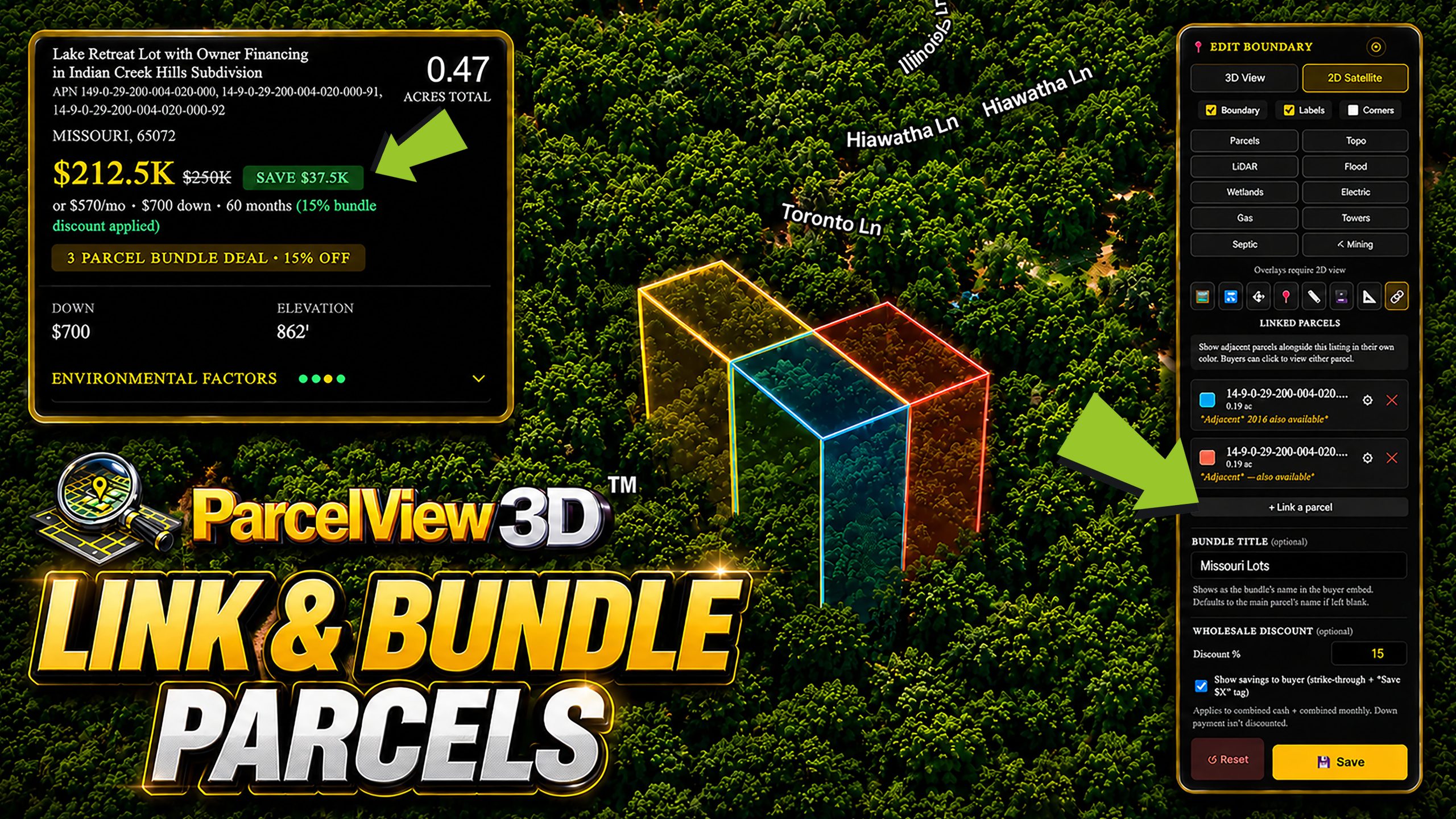
- Color-coded boundaries let buyers instantly tell the parcels apart, so a block of five lots reads as a clear, organized package instead of a confusing tangle of lines.
- Optional labels — “North Lot,” “Parcel 2,” “Bundle Lot A” — give you and the buyer a shared vocabulary for follow-up, so “the one with road frontage” becomes a name you both point to.
- One interactive view shows how the parcels relate: the contiguous acreage, the shared access, the full footprint of the opportunity. The buyer finally sees the assemblage the way you saw it when you bought it.
The shift in buyer psychology is immediate. They stop evaluating a small lot and start evaluating an investment. (The step-by-step setup is covered in our How to Link & Bundle Parcels guide — this article is about why it moves deals.)
The pricing move that creates urgency
Bundling isn’t just a presentation trick — it’s where you make the package feel like a deal worth acting on. PV3D gives you three controls that work together:
- A bundle title that frames the opportunity in the buyer’s language — “47-Acre Investment Bundle,” “3-Lot Lake Area Package.” The title does the positioning before the buyer reads a single number.
- A wholesale discount on the full package (say, 15% off buying the lots together) that rewards the buyer for taking the whole thing — and moves your entire inventory in one transaction instead of five.
- A Show Savings toggle that displays the original price with a strikethrough, the discounted bundle price, and the total savings. When a buyer sees exactly what they save by taking the package, the math makes the decision for them.
That strikethrough is quietly doing the hard work of your sales pitch. The buyer doesn’t just see a price — they see a reason to buy now, and to buy all of it. If you’d rather keep it clean, flip Show Savings off and display the single bundle price. Your call, per listing.
One link, one conversation, real signal
Here’s the operational payoff most sellers underestimate: a bundle is one shareable link, not five. Text it, email it, drop it in a social post, send it to your buyer list — the entire opportunity travels as a single, professional presentation.
And because it’s one listing, your analytics finally tell a coherent story. You can track listing opens, property views, engagement time, and which parcels buyers actually interacted with — so you know whether a buyer is circling the whole package or fixated on one lot, and you follow up with that in hand instead of guessing across five disconnected listings.
When to bundle (and when not to)
Link & Bundle earns its keep whenever the parcels are stronger together than apart:
- Adjacent lots acquired from the same seller
- Contiguous acreage that reads as small in pieces but substantial as a block
- Amenity clusters — a lake-area, road-frontage, or feature grouping where the grouping is the selling point
- Whole-inventory moves — any assemblage where you want to sell everything in one transaction
If your parcels are genuinely scattered across different markets and appeal to different buyers, separate listings may still be right. But if you bought them as a package — market them as one.
The bottom line
You already did the hard part: you assembled an opportunity worth more than its pieces. Don’t give that value back by chopping it into lonely listings that compete with each other and hide the thing that makes them good.
Link the parcels, name the package, show the savings, and send one link. Let buyers see what you saw.
Stop selling your best deals in pieces.
Link your adjacent parcels into one high-value bundle in ParcelView3D — color-coded, priced to move, and tracked end to end. Start your free trial →