If you’ve spent the last three years watching your Zillow views climb while your inquiries flatline, you’re not imagining it. Something has shifted in how rural land actually gets sold — and most of the sellers still treating Zillow and Realtor.com as the top of the funnel are missing where the buyers are now.
The buyers are on Facebook. They’re on Instagram. And the gap between what those platforms deliver for rural and recreational land versus what the traditional residential portals deliver isn’t shrinking. It’s widening.
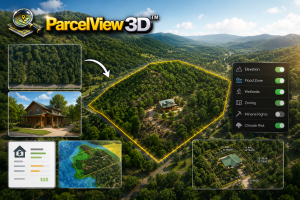
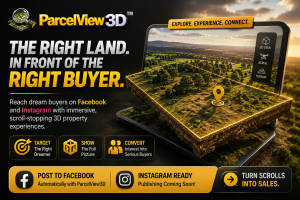
ParcelView3D was built specifically for this shift — to give rural land sellers a 3D-anchored listing experience and a social-first distribution pipeline in the same product. Here’s what’s actually happening in the rural land market in 2026, why the channel mix has flipped, and how ParcelView3D fits into the new playbook.
Zillow was never built for rural land — and it’s starting to show
Zillow and Realtor.com were built around a specific kind of transaction: a residential buyer in a known market, with a known school district, a known commute, and a financed offer through a traditional lender. The platform’s entire discovery model — saved searches, neighborhood pages, price-per-square-foot benchmarks — assumes the buyer already knows roughly where they want to buy.
Rural land buyers don’t work that way.
A typical recreational land buyer in 2026 isn’t searching “10 acres in Polk County.” They’re searching for a lifestyle: a hunting tract, an off-grid build site, a weekend getaway, a place to park a Class B and a side-by-side. The specific county is downstream of the lifestyle, not upstream of it. They’ll consider parcels across three states if the right one shows up in their feed.
Zillow’s discovery engine simply doesn’t reach those buyers. The filters don’t surface owner-financed deals well. The categorization buckets raw land in with farms, ranches, and fixer-uppers. And the algorithm prioritizes residential transaction velocity, which rural land — by definition — doesn’t have.
The result: lots of impressions, low intent, and inquiries that ghost.
Why Facebook Marketplace quietly took over
Facebook Marketplace doesn’t look like a real estate platform. That’s exactly why it works for land.
Buyers browsing Marketplace are in a mode the residential portals can’t replicate: open-ended discovery. They’re not running a saved search. They’re scrolling. And rural land, with its strong visual story and lifestyle pull, lands in that scroll the same way a vintage truck or a fishing boat does — as an aspirational object first, a transaction second.
A few structural advantages compound this:
- Free listings, unlimited photos, no syndication fees. The cost structure is the opposite of Land.com’s network. You can list a $25,000 parcel without paying $50 per month for placement.
- Local Facebook Groups are still the most underrated distribution channel in land. “Land for Sale in [Region]” groups have tens of thousands of members and zero gatekeeping. A single post in the right group can outperform a month of Zillow impressions.
- Direct messaging without a lead form. Buyers ask the questions they actually want answered — perc test status, road access, mineral rights — without filling out a form that triggers a CRM cadence. The conversation is closer to a text thread than a sales funnel.
- Geo-radius targeting is loose, which is good for land. Rural land buyers often live two states away. Facebook’s discovery model surfaces parcels to out-of-market buyers in a way that residential portals don’t.
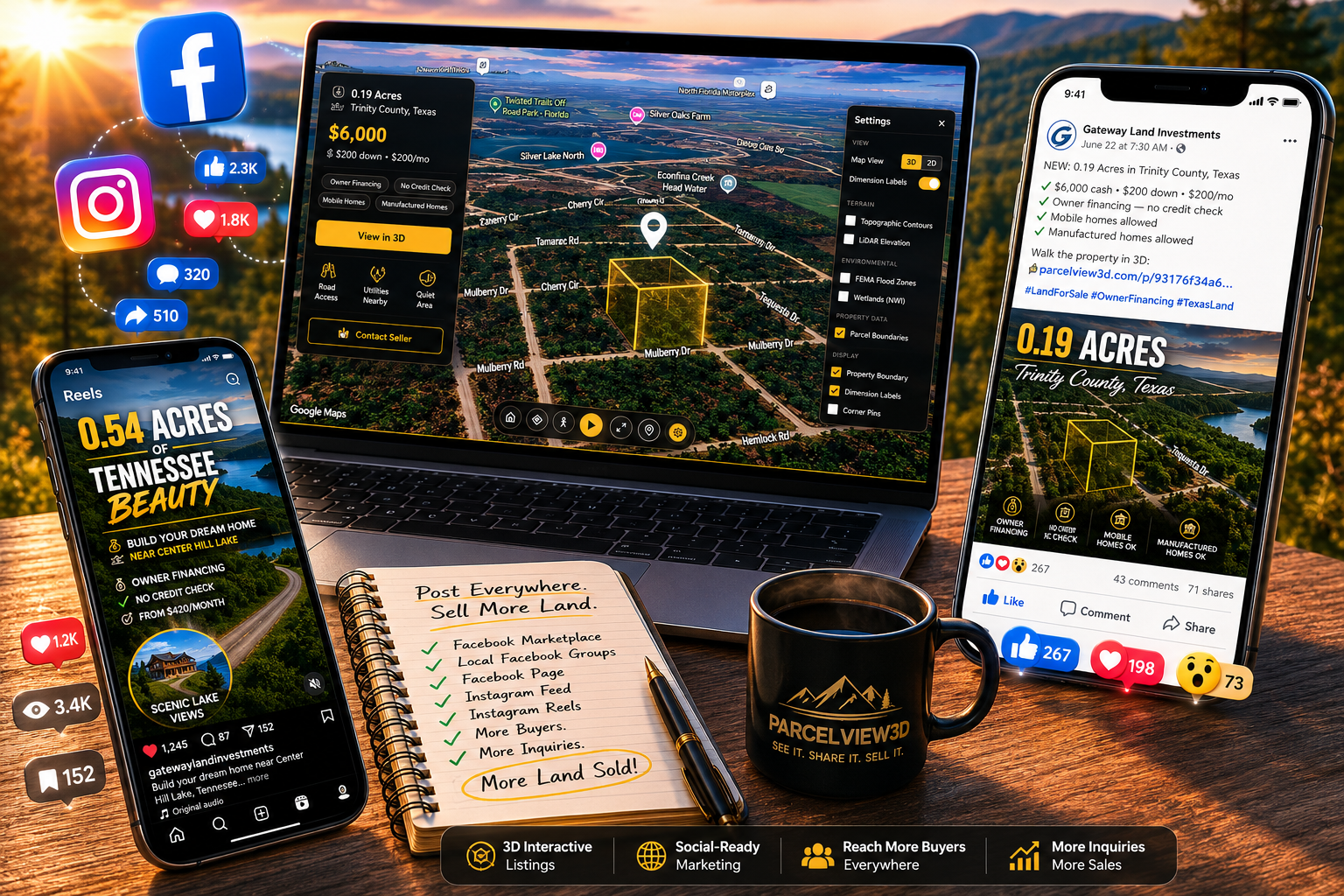
Sellers who post the same parcel on Zillow and on Facebook Marketplace routinely report the Facebook listing pulling 3–5x the inquiry volume — at zero listing cost. ParcelView3D was designed to feed that channel directly: every parcel in your inventory becomes a ready-to-post package, with a PropCard image, headline, price, acreage, and a deep link back to a fully interactive 3D listing page.
Instagram is where the lifestyle sale happens
Instagram works differently than Marketplace, and the buyer it reaches is different too.
Marketplace is a transactional surface. Instagram is an aspirational one. Reels of a parcel at sunrise, a slow rotation around a 3D model, a walkthrough of a ridgeline build site — those formats don’t close a sale, but they fill the top of the funnel with buyers who already feel something about the land before they’ve read the price.
The platform also rewards specific content shapes:
- Short vertical video (Reels) is consistently outperforming static images on reach.
- Carousel posts that combine an aerial, a 3D model rotation, and a few ground-level frames are converting better than single-image posts.
- Stories drive direct messages, which (like Marketplace) bypass the lead form entirely.
The Instagram audience for rural land skews younger and more urban than the Zillow audience for the same listings. These are the buyers planning a five-year exit from a metro — and they’re shopping land years before they’re shopping a closing date. If you’re not in front of them now, you’re not on the shortlist later. ParcelView3D’s Instagram Business integration handles the publishing layer, so the same 3D-anchored parcel content that lives on your listing page can be pushed to Instagram on cadence without you opening the app.
The bottleneck: most sellers can’t post enough
Here’s where the channel shift breaks down for most land sellers.
Facebook and Instagram reward cadence. Posting one parcel once a week to one group will not move the needle. Posting every active parcel, multiple times, across Marketplace, groups, your Page, and Instagram, with fresh creative each time — that moves the needle. But it’s also a full-time job, and most land sellers don’t have a marketing hire.
This is the operational problem ParcelView3D was built to solve.
Instead of hand-building a post every time a parcel goes live or gets a price drop, ParcelView3D generates a complete social-ready package for every parcel in your inventory — including a custom PropCard image, the headline copy, the price, the acreage, the location, and a deep link back to a fully interactive 3D parcel page. That package is then posted directly to your Facebook Page and Instagram Business account, on whatever cadence you set, without you opening either app.
The result is something rural land sellers haven’t really had before: distribution at portfolio scale, on the channels where buyers actually are, with content that doesn’t look like everyone else’s flat aerial drone shot.
Inside ParcelView3D’s automated Facebook and Instagram publishing
The piece most sellers underestimate when they hear “auto-posting” is how much manual work is actually buried inside posting one parcel to one channel. Size the image. Write the headline. Pull the price and acreage. Add the location. Write the description. Drop in the link. Pick the right Group or Page. Hit post. Then start over for the next parcel — and the one whose price just dropped — and then start over again next week, because Marketplace listings expire.
ParcelView3D collapses that whole workflow into a connection step you do once.
When you link your Facebook Page and Instagram Business account inside the PV3D Hub, every parcel in your inventory immediately becomes a publishable unit. The platform automatically generates a custom PropCard image for each parcel — a branded tile that pulls the headline render, the acreage, the price, and the location into a single image sized correctly for both Facebook and Instagram feeds. The caption is generated from the parcel record. The link points back to the parcel’s 3D-anchored listing page. The post fires on whatever schedule you set — daily, weekly, on price drops, on new listings, or on a custom cadence built around your portfolio.
A few things this unlocks that hand-posting can’t:
- Portfolio-wide cadence without burnout. If you have 40 active parcels, you are never going to post all 40 every week by hand. PV3D will. That alone is the difference between a Facebook Page that looks active and one that goes dark by month two.
- Re-posting that doesn’t trip the algorithm. Marketplace and Instagram both reward fresh content and penalize obvious duplicates. PV3D rotates PropCard images, captions, and post timing so the same parcel can stay in front of buyers across multiple touch points without looking like spam.
- Verified Instagram Business publishing. PV3D’s Instagram integration uses the official publishing path Meta sanctions for verified business tools, which means posts go up reliably without the rate-limit issues and account flags that hit unofficial scheduling tools.
- A single source of truth across channels. When you update a price in PV3D, the next scheduled Facebook and Instagram posts reflect that price automatically. There is no second system to keep in sync. The listing page, the PropCard, the social post, and the parcel record are all the same record.
For a seller with 20–50 active parcels and no marketing team, the practical effect is simple: every parcel gets published consistently across both channels, every week, without anyone touching a post composer. That is a level of distribution most rural land sellers have never had access to — and it is the operational layer that makes the social-first channel mix actually work at portfolio scale.
Why the ParcelView3D 3D layer matters more than people realize
The reason ParcelView3D’s social posts outperform standard listing photos isn’t the automation. It’s the underlying content.
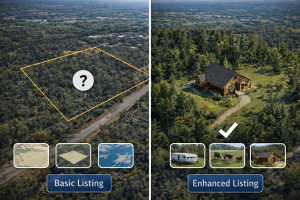
Every parcel on a ParcelView3D listing page is presented as an interactive 3D environment — terrain, parcel boundary, surrounding context, and a walkable, rotatable view of the land itself. Buyers don’t just look at the property. They explore it. They tilt it, spin it, drop a homesite on it, see how it sits relative to the road and the neighbors.
When a buyer clicks a Facebook or Instagram link and lands on that experience instead of a flat photo grid, the dwell time on the listing roughly triples. That dwell time is the single strongest predictor of an inquiry. And because the 3D experience answers most of the questions a buyer would otherwise have to ask, the inquiries that do come through arrive better-qualified and further down the funnel.
Other tools in the land space, like Land id, have helped sellers move beyond the traditional plat map view. ParcelView3D goes meaningfully further: it delivers a true interactive 3D listing experience, a built-in social publishing pipeline, and a unified product where the visualization, the listing page, the PropCard image, and the posting workflow all live together. For a seller running a portfolio of owner-financed parcels and feeding two or three social channels every week, ParcelView3D removes the operational friction that usually kills a social strategy by week three — and gives buyers a richer, more engaging way to explore the land than anything else in the category.
What a ParcelView3D-powered channel mix looks like in 2026
The sellers winning rural land inquiries in 2026 aren’t the ones with the biggest Zillow spend. They’re the ones running a layered distribution stack — and ParcelView3D was designed to power every layer of it:
- Facebook Marketplace as the primary transactional surface — every parcel, every market, refreshed regularly through ParcelView3D’s post pipeline.
- Facebook Groups for hyperlocal reach — the same ParcelView3D-generated listings, distributed to land-buying communities in the target region and adjacent states.
- Instagram Reels and carousels for top-of-funnel lifestyle reach — 3D rotations, sunrise terrain, build-site walkthroughs, all sourced from the parcel’s ParcelView3D page.
- A 3D-anchored ParcelView3D listing page as the destination for every post — the place where the lifestyle pull turns into a qualified inquiry.
- Zillow and the Land.com network as supporting channels, not lead channels — useful for SEO surface area, but no longer the engine.
Notice what’s not in that stack: a $300/month Land.com subscription as the only line item, or a Zillow listing with three photos and a hope.
The channels have changed. ParcelView3D was built for the channels that won.
The buyers haven’t disappeared. The rural land market isn’t shrinking — by most measures it’s still expanding, with owner-financed inventory in particular continuing to outperform broader real estate. The buyers have just moved.
They’re scrolling Marketplace at 9 p.m. on a Tuesday. They’re watching land Reels on Instagram during lunch. They’re DMing sellers directly instead of filling out lead forms. And they’re closing on parcels they first saw in a feed, not on a portal.
The sellers who meet them there — with the right cadence, the right content, and a listing experience that justifies the click — are the ones still picking up the phone. ParcelView3D was built end-to-end for that motion: 3D-anchored listing pages, automated social-ready PropCard images, direct publishing to Facebook and Instagram, and a buyer experience that turns a casual scroll into a qualified inquiry.
If you want to see what a ParcelView3D listing looks like on one of your own parcels, request a demo and we’ll set one up.
ParcelView3D is the 3D parcel visualization and listing platform built for rural land sellers. Explore features · See pricing · Request a demo