PARCELVIEW3D · COMPARISON GUIDE
Why the number that used to take a week of phone calls now takes twelve seconds — and why it works harder once you have it.
Every land deal eventually runs into the same question. A buyer looks at four and a half acres of raw ground, likes what they see, and asks what it would cost to put a house on it. It is a fair question. It is also the question that stalls more land deals than price ever does, because the honest answer from most sellers is some version of “let me find out and get back to you.”
That gap — between the moment a buyer gets interested and the moment they get a number — is where deals go cold. This guide compares the traditional way of answering that question against ParcelView3D’s Property Cost Estimator and looks at what changes when the answer stops being a follow-up task and starts being part of the listing itself.
The traditional way of estimating construction costs
Traditional construction estimating is not wrong. It is thorough, it is defensible, and for a project that is about to break ground it remains the standard. But it was designed for a builder pricing one committed project, not for a land seller who needs a credible ballpark on forty listings at once.
Run through what it takes to produce one estimate on one parcel:
- Pull the parcel record, acreage, slope, and access details by hand.
- Call two or three builders and wait for callbacks that may or may not come. Courtesy bids on land you do not own yet are a favor, and favors run out.
- Chase separate quotes for the well and the septic, each with its own scheduling delay.
- Guess at electric service and driveway costs based on how far the nearest pole looks on a map.
- Reconcile all of it in a spreadsheet, add the land price, and produce a total.
- Start over completely on the next parcel.
Realistically that is five to twelve days and a few hours of your own time per property. Generic online cost calculators shorten it, but they trade away the part that matters they price a house, not a site. Ask a national cost-per-square-foot calculator about a 4.86-acre tract and it has no idea whether that tract needs a 480-foot well, 260 feet of gravel driveway, and a full acre of clearing before a foundation can be poured. On rural land, site prep is frequently the difference between a deal and a disaster, and it is exactly the part the generic tools skip.
What ParcelView3D’s Property Cost Estimator does instead
ParcelView3D approaches property planning with a built-in Cost Estimator designed around the specific property. From the Cost Estimator, users can select the types of properties they want to estimate, including Single-Family Homes, Manufactured Homes, Mobile Homes, and other available options. They can also account for custom square footage and utility requirements such as a well and septic system.
The estimator provides additional display options, including Site Prep Costs, Division Breakdown, Cost Per Sqft, and Total Investment. After generating the estimates, users can review the projected cost ranges for their selected property types, giving them a clearer picture of potential development and construction costs.
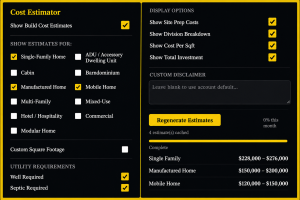
Figure 1 — The Property Cost Estimator provides build cost estimates with options for site prep costs, cost breakdowns, cost per square foot, total investment, and utility requirements.
A few things are worth calling out about the Cost Estimator. It lets you generate cost estimates for different property types, including single-family homes, manufactured homes, mobile homes, and other available options. You can also enter a custom square footage and account for utility requirements such as a well and septic system. The display options provide additional details, including site prep costs, cost breakdowns, cost per square foot, and total investment. Once the estimates are generated, you can review the projected costs for each selected property type along with site prep and utility costs—all in one place.
Feature comparison
Side by side, across the capabilities that determine whether an estimate helps you close:
| Capability | Traditional construction estimating | ParcelView3D Property Cost Estimator |
| Turnaround per parcel | Days to weeks — dependent on builder and contractor callbacks | Seconds — generated on demand from the property record |
| Cost per estimate | Your hours, plus the goodwill you spend asking for courtesy bids | Included in the plan; 25 estimates per month on Growth |
| Site visit required | Usually yes, for anything involving well, septic, or grading | No — the estimate is built from the parcel record |
| Regional accuracy | Only as current as the last quote you collected | Priced against live regional cost data for that county |
| Site prep coverage | Separate quotes for well, septic, electric, driveway, clearing, foundation | All six-line items returned together in one breakdown |
| Well feasibility | Driller opinion, often after a scheduling delay | Scored automatically from public groundwater records |
| Septic suitability | Perc test or soil consultant | Scored automatically from published soil analysis |
| Total investment math | Manual spreadsheet: land plus build plus site prep | Calculated and displayed as one Total Estimated Investment |
| Buyer-facing output | A PDF or an email you have to send and re-send | Published directly on the live 3D listing and PropCard |
| Reuse across a portfolio | Start over on every parcel | County-level caching serves the next parcel instantly |
| Scales with volume | Gets slower as your inventory grows | Gets faster as your county coverage builds |
| Sits next to the property | Lives in a folder, separate from the listing | Lives inside the same platform as the 3D viewer and lead form |
Speed is the headline. Repeatability is the real advantage.
The twelve-second number gets attention, but it undersells what changes at portfolio scale. Traditional estimating gets harder as you grow — every new listing is another round of phone calls, another set of quotes, another spreadsheet. ParcelView3D moves in the opposite direction. Because estimates are cached at the county level, the first parcel you run in a county does the work and every parcel after it in that same county returns instantly. If you buy in clusters, which most land investors do, your estimator gets faster exactly as your inventory gets bigger.
The part that moves deals: buyers see it too
This is where the comparison stops being about efficiency. A traditional estimate ends up as a PDF in your folder that you email to whoever asks. The ParcelView3D estimate publishes straight onto the live listing and PropCard, sitting right beside the interactive 3D view of the parcel. The buyer who is already rotating the terrain and checking the road frontage scrolls down and finds the build math waiting for them.
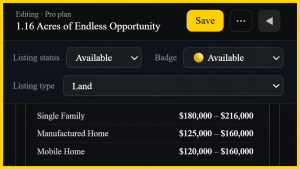
Figure 2 — The buyer-facing property listing displays estimated costs for different property types, helping buyers compare potential development options for the property.
Two things happen when you do that. Tire-kickers self-select out, because someone who was never going to fund a $245,000 total investment now knows it before they take an hour of your time. And serious buyers get more serious, because you have answered the objection, they were about to raise before they raised it. Sellers who publish build costs consistently report shorter email threads and better-qualified calls — the conversation starts at financing terms instead of starting at “so what would it cost me to build?”
For ADU and home builders the same mechanic works as a bidding tool. You can walk into a homeowner consultation, pull up their lot, and give them a defensible ballpark on the spot, complete with a concept rendering of what the finished build could look like. Competitors are still promising to get back to them next week.
Where traditional estimating still belongs
Worth being straight about this, because overclaiming helps nobody. The Property Cost Estimator is built to qualify buyers and price opportunity fast — it is not a permit set and it is not a construction contract. When a buyer is ready to break ground, they still want a licensed builder walking the site, a real perc test, and a hard bid with a signature on it. The feasibility scores flag likely conditions; they do not replace the driller.
What ParcelView3D does is put a credible number in front of a buyer on day one instead of day twelve, so the deal survives long enough to reach the stage where a hard bid makes sense. Those are different jobs, and the estimator is very good at the one it was designed for.
Getting to it
The Property Cost Estimator is included on the Growth plan at $99 per month with 25 estimates monthly, and on the Pro plan at $199 per month for higher-volume operators. Both include the full 3D listing platform, overlays, PropCards, analytics, and lead capture, and both start with a seven-day free trial with no card required.
The bottom line: traditional estimating produces one careful number, slowly, that lives in a folder. ParcelView3D produces a credible, site-specific number in seconds, keeps producing them as your portfolio grows, and puts each one directly in front of the buyer who needed it. For a land seller trying to move inventory, that is not a marginal improvement in workflow — it is the difference between answering the question and losing the buyer who asked it.
Start your seven-day free trial at parcelview3d.com — three properties free, no card required.