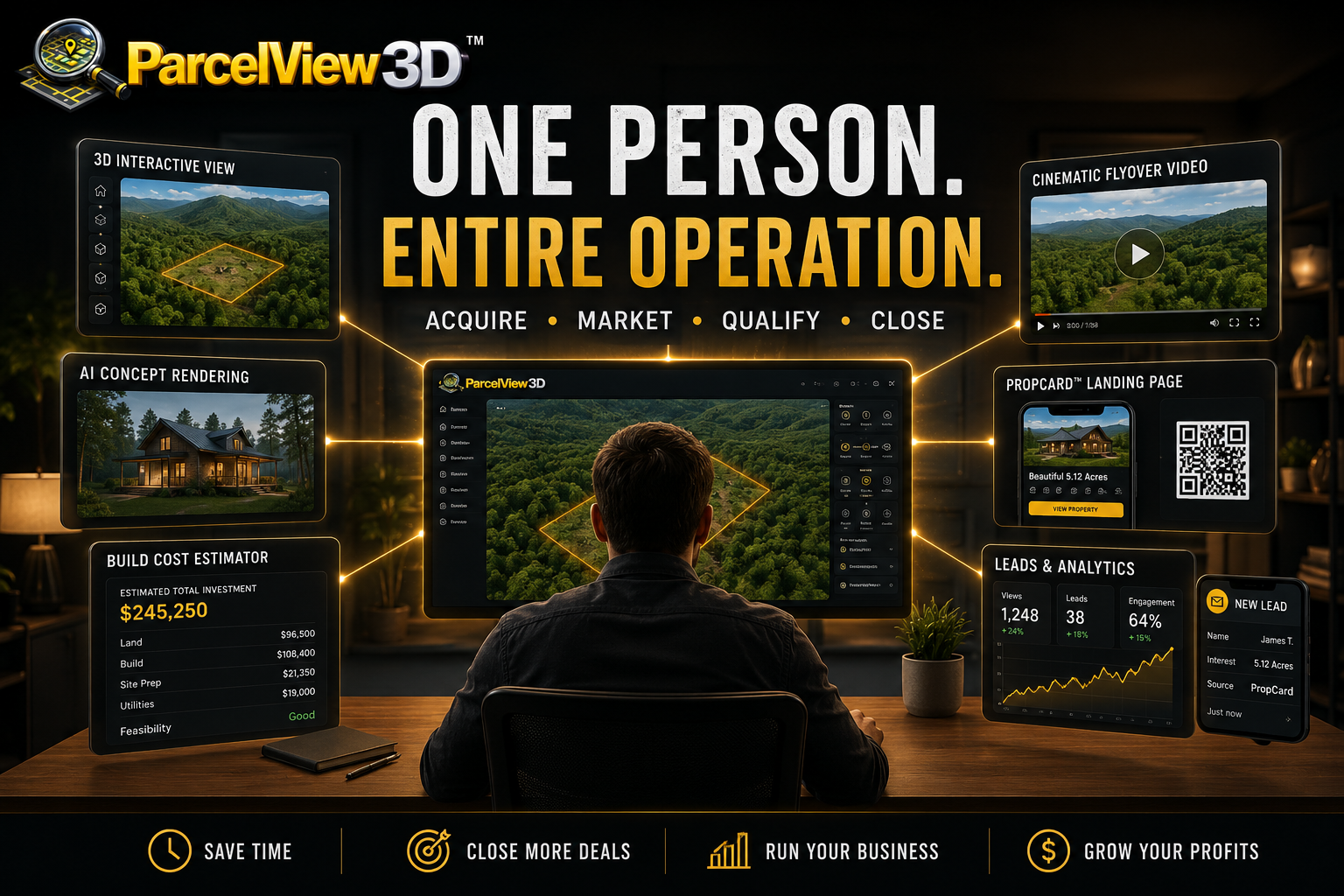
You are the acquisitions team, the marketing department, and the closer. Here is the workflow that makes that survivable — and profitable.
Nobody sets out to run a land business alone. It just happens. You do one deal, it works, so you do three. Then twelve. And somewhere between the twelfth and the twentieth, you notice that you are not really a land investor anymore — you are a one-person agency with a land portfolio attached. You are pulling comps on Monday, driving out to shoot photos on Tuesday, fighting with a video editor on Wednesday, answering the same six buyer questions on Thursday, and doing paperwork on Sunday night because there was nowhere else to put it.
The instinct is to hire. But the honest math on a small land operation rarely supports a marketing hire, a videographer, and a designer — not on deals that clear a few thousand dollars each. What actually scales a solo operation is not more people. It is a stack: a small set of tools that compress the work so that one person can run the whole lifecycle without dropping the thread.
This is what that stack looks like when it is built around ParcelView3D.
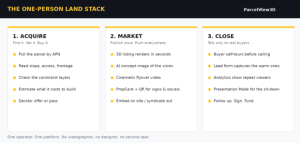
The three stages a solo land operator has to run, and what each one actually requires.
Stage 1: Acquisition — decide from your desk
The most expensive habit in a solo operation is driving. Every parcel you visit before you have a reason to visit it is half a day you did not spend on inventory that was actually going to sell.
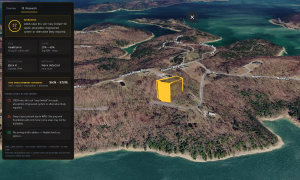
The fix is to move as much of the go/no-go decision as possible to the desk. Enter the parcel number, and ParcelView3D builds a photorealistic, fully interactive 3D view of it in seconds — real terrain, real elevation, boundaries drawn where they actually fall. You are not squinting at a flat plat map trying to imagine the drop-off at the back of the lot. You are flying it.
From there, the questions that decide a deal get answered in the same session:
- Does it slope hard where you would want to put a house pad?
- Is the road frontage real frontage, or is it a right-of-way on paper?
- Do the constraint overlays — flood, wetlands, zoning, mineral rights, climate risk — kill the buildable envelope?
- What would it actually cost a buyer to build here, once you account for well, septic, electric, driveway, and clearing?
That last question is the one most solo investors answer with a shrug and a guess. The AI Build Cost Estimator answers it with regional pricing, a well feasibility score, and a septic suitability read — before you have written an offer. If the total investment number is ugly, you pass, and you saved yourself a Saturday.
| The acquisition rule of thumb
If you cannot articulate what a buyer would build on the parcel and roughly what it would cost them, you do not understand the deal yet. Answer that at the desk, not on the tailgate. |
Stage 2: Marketing — publish once, push everywhere
Here is where solo operations quietly bleed. You bought well, you priced it right, and then the listing goes out as a single washed-out aerial photo and a paragraph of text, because that is all you had time to produce. The parcel is fine. The presentation is what is killing it.
On a ParcelView3D workflow, the marketing package assembles itself from the same listing you already built during acquisition:
- The interactive 3D listing — the buyer flies the parcel from any angle, at any zoom, on their phone, at 11pm, without you on the phone.
- An AI concept rendering — the cabin, the barndominium, the ADU, the homestead — placed on the actual property, so a buyer stops guessing at potential and starts seeing it.
- A cinematic flyover video, auto-generated, formatted for the places buyers actually scroll.
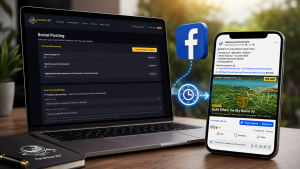
- A PropCard™: a mobile-first landing page with the 3D viewer, photos, concepts, video, pricing, and a lead form, all behind one shareable link and one printable QR code.
The QR code is the underrated piece for a one-person shop. It goes on the yard sign, the flyer, the business card, the back of the truck. Someone driving a county road at dusk scans it and is inside your 3D listing thirty seconds later — while you are at home eating dinner. That is a showing you did not have to attend.
Stage 3: Qualification — let the listing do the screening
The single biggest tax on a solo operator is the unqualified buyer. The person who emails six times, asks for a call, schedules a drive-out, and then discovers on-site that the back half is wet, or that there is no power at the road, or that the slope will not take the shop they wanted. That is not a bad buyer. That is a buyer who was never given the information up front.
A listing that answers the questions in advance filters people for you. Three answers do most of the work:
- What does it look like out there? — answered by the 3D view and flyover.
- What can I put on it? — answered by the concept renderings and the buildable-area picture.
- What will it cost me all-in? — answered by the published build cost estimate.
Buyers who work through all three and still fill out the lead form are qualified in a way that a buyer who clicked a photo never is. And because engagement is tracked at the listing level, you can see which prospects came back a second and third time — which tells you exactly who to call first on Monday morning.
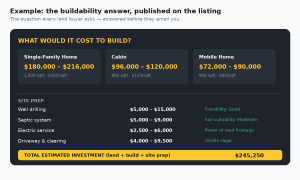
Example build cost estimate published directly on a listing, so the buyer’s biggest question is answered before they ever contact you.
Stage 4: Closing — show up with more than a phone
When the qualified buyer does sit down with you — in a kitchen, at a coffee shop, at a title office — you do not want to be scrolling a camera roll. Presentation Mode turns the listing into a widescreen walkthrough: the 3D view, the gallery, the concepts, the video, the pricing, all in one place. At the end, they scan the QR code and the whole property leaves with them on their phone.
For an operator with no sales team, that is the difference between a conversation and a presentation. And it costs you nothing extra to produce — it is the same listing you built the day you bought the parcel.
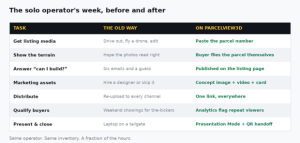
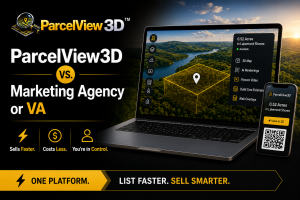
The same seven tasks, run the old way and run on a single platform.
How this compares to the alternatives
Most solo investors have already tried to solve this with something. It is worth being clear-eyed about what those options do well and where they leave a one-person operation exposed.
| APPROACH | WHERE IT WORKS | WHERE PARCELVIEW3D WINS |
| Hiring a drone videographer | Beautiful footage on a hero listing you are willing to invest in. | ParcelView3D produces listing-ready 3D, concepts, and video remotely, in minutes, at a price that works on every parcel — not just the expensive ones. |
| Residential 3D tour tools (Matterport-style walkthroughs) | Genuinely excellent for houses — room-by-room interior capture is what they were built to do. | ParcelView3D is purpose-built for land. It shows terrain, slope, frontage, boundaries, and buildability — the things a land buyer decides on — with no site visit and no capture equipment required. |
| Flat marketplace photos and a plat map | Free, fast, and better than nothing. | ParcelView3D turns the same parcel into an experience a buyer can explore — which is what keeps them on the listing long enough to become a lead. |
None of these are bad tools. They are simply built for a different job than the one a solo land investor does every week. ParcelView3D was built by a land investor for exactly that job — which is why the workflow above is one platform instead of five subscriptions and a folder of raw footage.
The one-person economics
The reason this stack matters is not that it is prettier. It is that it changes the shape of the business. When one operator can take a parcel from acquisition to a fully marketed, self-qualifying 3D listing in an afternoon, two things follow:
- You can carry more inventory, because inventory no longer costs you a day of production each.
- You can turn inventory faster, because the listings do the pre-selling — and faster turns mean the same capital does more deals per year.
That is the whole game for a solo operation. Not working more hours. Working the same hours across more parcels, with a listing that keeps selling after you have closed the laptop.
See it on your own parcel
The fastest way to understand this workflow is to run one parcel through it. Enter an APN, watch the 3D listing build, generate a concept image, and send yourself the PropCard link.
Book a 15-minute walkthrough: parcelview3d.com/demo
Or start the 7-day free trial — no card required, three properties free: parcelview3d.com
ParcelView3D™ — built by land investors, for land investors.