Walk any vacant-land seller through their listing analytics and you’ll see the same pattern: hundreds of clicks, dozens of saves, a handful of inquiries — and a conversion rate that would get a residential agent fired. The instinct is to blame pricing, blame the market, blame the lead source. The real culprit is something quieter and far more expensive: the trust gap.
In residential real estate, a buyer can walk a house, smell the kitchen, count the outlets, and decide in an afternoon. In land, that same buyer is asked to wire five or six figures based on a flat satellite snapshot, a parcel polygon, and a paragraph of copy. The asymmetry is enormous — and most of the industry hasn’t caught up to what it’s costing them.
The 60-second window
Multiple studies of online real estate behavior have converged on a brutal truth: most buyers form a decision to keep reading or bounce within roughly the first minute on a listing page. For improved residential property, that minute is usually enough — photos load, layouts read intuitively, and trust accumulates passively.
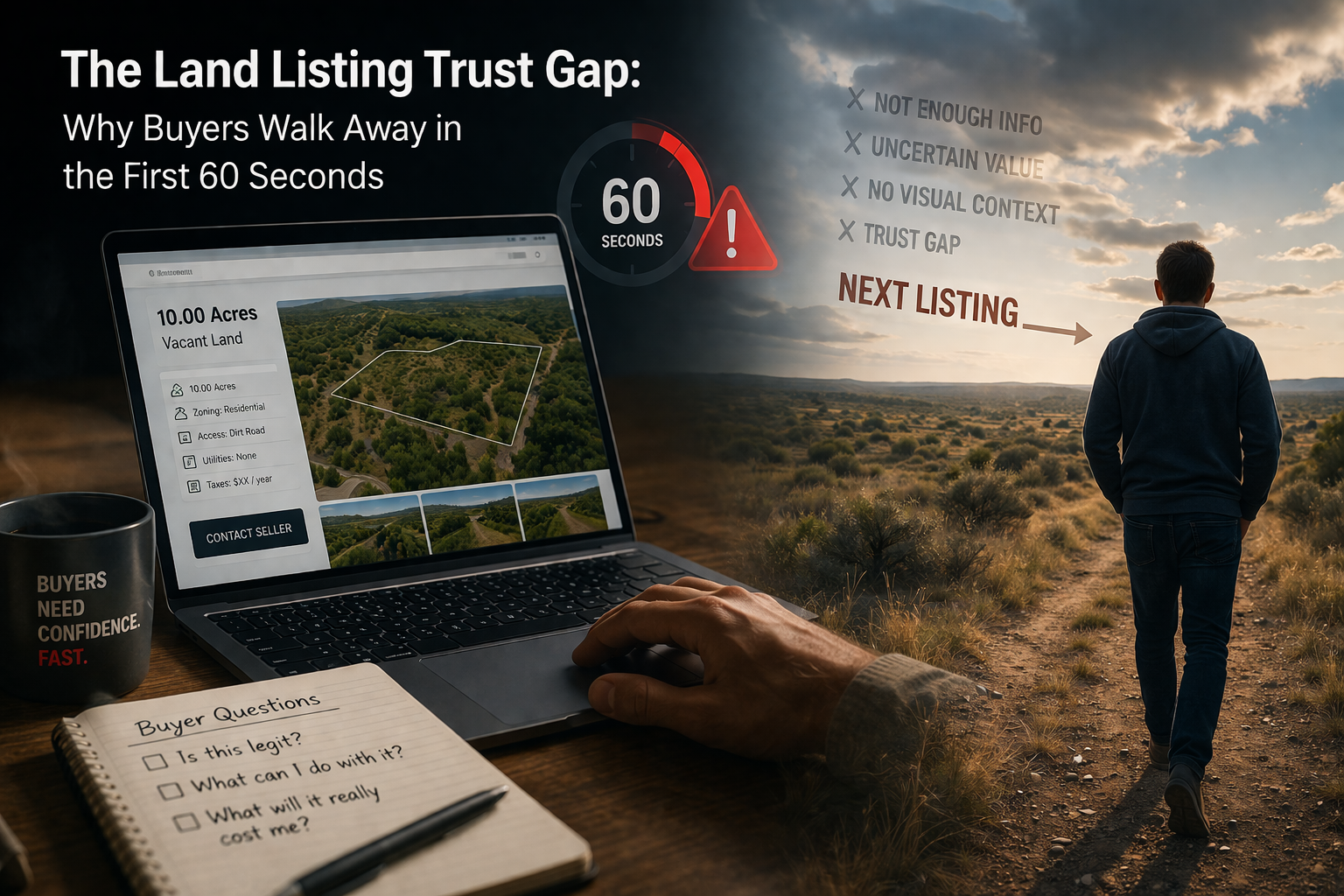
For vacant land, that same minute is when buyers ask three questions the listing almost never answers:
- Is this property actually what the seller says it is?
- What can I do with it?
- What will it really cost me to do that thing?
A flat aerial image and a bullet list of acreage data answers none of these. So the buyer leaves, often without filling out a form — which means the seller never even knows they were there. The lead doesn’t churn; it evaporates.
This is the trust gap. And it’s the single largest unmonetized variable in vacant-land sales today.
Why traditional listings fail at trust
Land has always been the awkward stepchild of real estate marketing. The MLS systems were built for houses. Most major listing platforms inherited a residential template and bolted on an “acreage” field. The result is a listing format that’s structurally incapable of doing what land buyers actually need it to do.
Consider what a typical vacant-land listing offers:
- A static aerial image, often months or years old
- A polygon overlay that may or may not match real boundaries
- A spec sheet of acreage, road frontage, and zoning codes
- A paragraph of seller-written copy
- Maybe a soil map, if the buyer knows to look
Now consider what the buyer is actually evaluating: whether this piece of dirt, sight unseen, will support the future they’re picturing. A homestead. A weekend cabin. A spec build. A pasture for two horses. An ADU rental.
The format and the question don’t match. The listing is selling acres; the buyer is buying possibility. That mismatch is the trust gap, expressed in product terms.
The cost of a 30-second exit
It’s tempting to treat bounced visitors as “not really buyers” — but the math doesn’t support that.
Industry tracking across vacant-land portals consistently shows that for every buyer who fills out a contact form, somewhere between 40 and 80 view the listing without converting. If even 10% of those non-converters are genuinely qualified — and conservative estimates suggest the real number is higher — the lost-pipeline cost on a single $80,000 listing can run well into the tens of thousands in unrealized commission and held-inventory carrying costs.
That’s the cost of one listing. Multiply by a portfolio of 30 or 50 active properties, and the trust gap stops being a marketing problem. It becomes the dominant economic constraint on the business.
The sellers who are quietly outperforming everyone else in 2026 aren’t running better ads. They’re closing the trust gap before the 60-second window expires.
What “closing the gap” actually looks like
Three behavioral shifts separate the listings that convert from the ones that bounce:
- They answer the spatial question immediately. A buyer who can see how a property sits in its terrain — how the slope falls, where the trees are, what the road approach looks like, what the neighbors look like from above — has had the equivalent of a remote walk-through. Trust isn’t argued; it’s demonstrated.
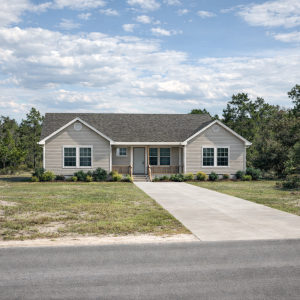
- They show what could be there, not just what is. Land is sold on imagination. The seller who hands the buyer a vision of what a 1,200-square-foot cabin would actually look like on the south corner of the lot has already done 80% of the closing work. The buyer who has to picture it themselves often picks the listing where they don’t have to.
- They remove pricing ambiguity. Land price is the small number; build cost is the big one. A listing that shows the all-in investment — land plus realistic build cost plus utilities — converts dramatically better than one that leaves the buyer to do their own back-of-envelope math, get scared, and click away.
When you stack those three together, you get something that no traditional listing format can deliver: a buyer who has, within their first sixty seconds, mentally moved in.
The tooling shift the industry is undergoing
This is where the market is bifurcating. On one side, the established data tools — platforms like LandGlide, which have built genuinely excellent parcel-data and lookup experiences. LandGlide is a workhorse for due diligence, owner research, and field-walking. If you’re a wholesaler trying to identify ownership patterns across a county, it’s a serious tool and deserves its place in the workflow.
But LandGlide and tools like it are built for the seller’s research phase, not the buyer’s decision phase. They answer “who owns this and what is it” — not “should I buy this and what could I build on it.” Pointing a retail buyer at a parcel-data tool is like pointing a homebuyer at the county assessor’s website. Technically informative. Practically a dead end.
ParcelView3D sits on the other side of that line. It’s not a research tool; it’s a presentation platform — designed specifically for the moment when a real buyer lands on a real listing and has to decide whether to keep reading. Photorealistic 3D views, AI-generated concept renderings, cinematic flyovers, build-cost estimates, and mobile-first PropCards aren’t features for the seller’s spreadsheet. They’re answers to the three questions a buyer is silently asking in their first sixty seconds.
The two tools aren’t really competitors — they serve different stages of the same business. But for sellers wondering where to spend the next marketing dollar, the question is whether you’re optimizing the workflow you already have, or closing the gap that’s quietly costing you deals.
What the early adopters are seeing
Sellers who have moved their listings into immersive presentation formats — interactive 3D, concept renderings, integrated build-cost previews — are reporting consistent patterns:
- Time-on-listing climbing from under a minute to four-plus minutes. Engagement isn’t a vanity metric in land; it’s a direct leading indicator of inquiry and offer.
- Inquiry quality rising sharply. Buyers who’ve already seen the property in 3D and the build cost broken out aren’t asking “is there a well?” — they’re asking “can I close in 30 days?”
- Days-on-market dropping by a third or more on comparable inventory. Faster turns mean less carrying cost, more capital cycling, more deals per year.
- Out-of-state buyers converting at near-parity with local buyers. This is the unlock. Vacant land has always sold poorly to remote buyers because remote buyers can’t trust what they can’t visit. Immersive presentation collapses that distance.
None of these are theoretical gains. They’re showing up in the listings of operators who have stopped treating vacant land like a residential listing missing a house, and started treating it like its own product category.
The professionalization of the land seller
Step back and the bigger picture comes into focus. The vacant-land market is undergoing the same professionalization that residential went through fifteen years ago. The solo flipper who used to rely on a Craigslist post and a Facebook Marketplace listing is now running branded storefronts, capturing analytics, presenting on a projector at networking events, and following up with leads through automated systems.
That shift is structural. Buyers are getting more sophisticated, deal sizes are climbing, and the operators who win the next decade will be the ones who treat presentation as a core competency — not an afterthought.
The trust gap is closing. The question for any seller, builder, or developer reading this is whether they’re closing it on their own listings, or watching their buyers walk into the listings of someone who already has.
Where to go from here
If your conversion numbers feel disconnected from your traffic numbers, the trust gap is almost certainly the variable to tune first. Better photography helps at the margin. Better copy helps at the margin. Closing the trust gap is the single change that moves the conversion rate, the days-on-market, and the average sale price all at once.
The simplest way to find out whether immersive presentation actually moves the needle on your listings is to test it on a few. ParcelView3D offers a free trial that lets you put two or three of your active properties into the format and watch what happens to engagement and inquiry quality. If the numbers move the way they’ve moved for early adopters across the industry, you’ll know within a couple of weeks. If they don’t, you’ve spent an afternoon and learned something useful about your audience.
Either way, the buyers aren’t waiting. The first sixty seconds are happening on every listing you have right now. The only question is what’s filling them.
Ready to close the trust gap on your own listings? Start your free ParcelView3D trial and see what happens when buyers actually get to spend their first minute exploring instead of leaving.